Overview
Razkom_v1.1 is a Windows x86-64 binary designed to exploit key validation by reversing the logic behind.
the objective is straightforward: analyze the program logic and build a keygen that generates valid keys.
For this challenge, I will be using IDA Free 9.2
Initial Recon
Running the binary prompts the user to enter a valid key in order to unlock the secret flag.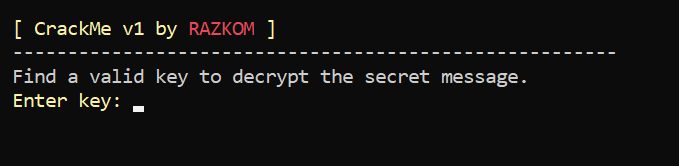
Program prompt requesting key
This challenge comes with a hint about the key format.
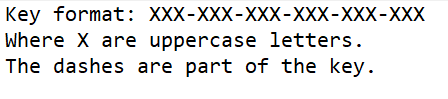
Key format hint
???-???-???-???-???-???
6 groups of 3 uppercase letters sepparated by a hyphen.
Now lets dig into the validation logic.
Static Analysis
We will search for the string that ask to enter the key, in IDA we can do it by pressing ALT+t.
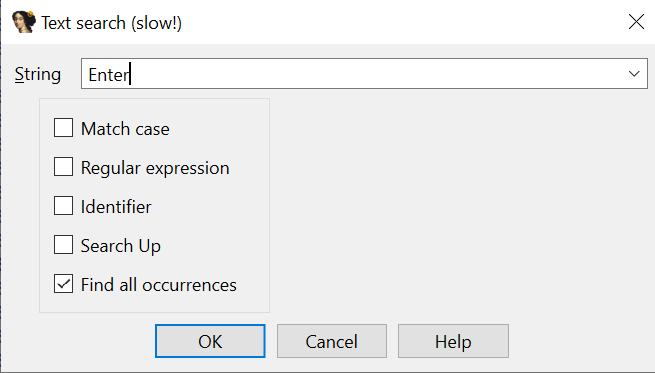
Searching 'Enter' string
Once we find all the ocurrences we can look for the interesting ones in the list.

Ocurrences list
Double click on the first one will get us to the Assembly code it references to, there we can chagne our view to graph flow by pressing SPACE BAR.
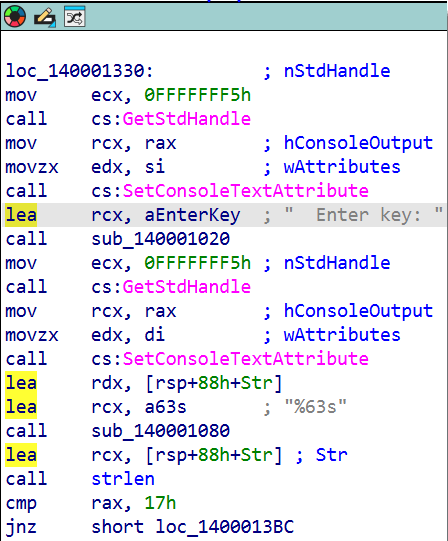
Graph view
Decompilation & Logic Analysis
We can switch to text view again to decompile the assembly into Pseudocode by pressing F5 so we have a much clean structure to look at.
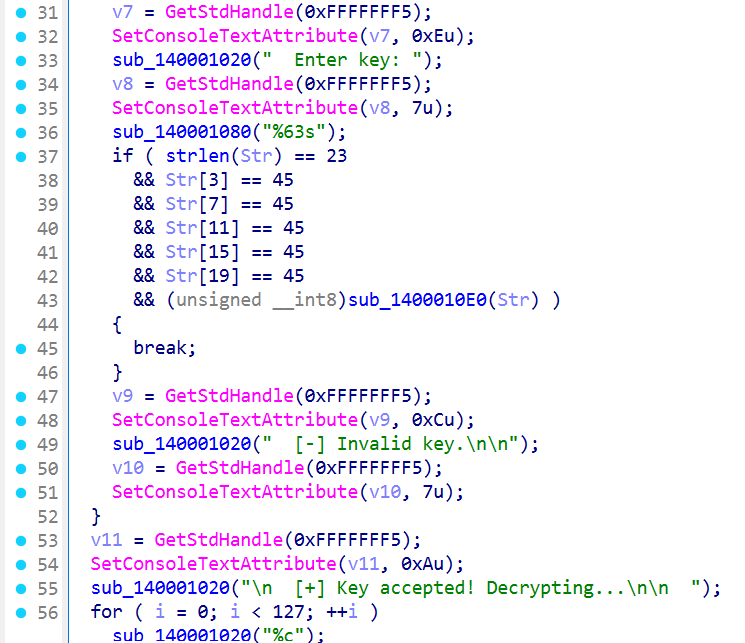
Decompiled code
Good!! We can already see som checks the code performs.
  if ( strlen(Str) == 23
      && Str[3] == 45
      && Str[7] == 45
      && Str[11] == 45
      && Str[15] == 45
      && Str[19] == 45
      && (unsigned __int8)sub_1400010E0(Str) )
This conditional checks for a few things, if the input key is not 23 fails validation and gives us the [-]Invalid key message.
Checks if the char in positions 3,7,11,15,19 is 45 that looking into the ASCII table we know it is " - “.
We can assure that this is a basic validation that checks the minimums, length and format as we saw on the hint.
If the validtion is passed it calls function sub_1400010E0() giving our input as parameter
Let’s dive into that function.
{
  int v2; // ecx
  int v3; // r8d
  int v4; // r8d
  int v5; // r8d
  int v6; // r9d
  int v7; // r9d
  bool result; // al
  result = strlen(a1) == 23
        && (v2 = a1[2], (*a1 + a1[1]) % 26 + 65 == v2)
        && (_BYTE)v2 == 82
        && (v3 = a1[6], (a1[4] + a1[5]) % 26 + 65 == v3)
        && (_BYTE)v3 == 65
        && (v4 = a1[10], (a1[8] + a1[9]) % 26 + 65 == v4)
        && (_BYTE)v4 == 90
        && (v5 = a1[14], (a1[12] + a1[13]) % 26 + 65 == v5)
        && (_BYTE)v5 == 75
        && (v6 = a1[18], (a1[16] + a1[17]) % 26 + 65 == v6)
        && (_BYTE)v6 == 79
        && (v7 = a1[22], (a1[20] + a1[21]) % 26 + 65 == v7)
        && (_BYTE)v7 == 77;
  return result;
}
Excellent!! Here it is where all the magic happens lets break it down into simple terms to understand it.
After the length check it does the following
(v2 = a1[2], (*a1 + a1[1]) % 26 + 65 == v2) && (_BYTE)v2 == 82
We can see that v2 is being assigned the value of the a1[2], this means that v2 stores the third character of the key.
Step 1 — Remove the Noise
Lets simplify that a little bit.
(a1[0] + a1[1]) % 26 + 65 == a1[2] && a1[2] == 82
Step 2 — Substitute the Constant
But we see at the end that the value of a1[2] must be 82, that number in the ASCII table corresponds to the letter “R”.
(a1[0] + a1[1]) % 26 + 65 == 82
Step 3 — Remove the ASCII Offset
Subtract 65 from both sides of the equation.
(a1[0] + a1[1]) % 26 = 82 - 65
(a1[0] + a1[1]) % 26 = 17
Step 4 — Move to Alphabet Space
Uppercase letters are ASCII:
'A' = 65
...
'Z' = 90
So define:
xi = a1[i] - 65
This maps:
A → 0
B → 1
...
Z → 25
Now the equation becomes:
x0 + x1 ≡ 17 (mod 26)
And
x2 = 17 (since a1[2] = 82 → 82 - 65 = 17)
What This Means
The first two characters must sum (mod 26) to 17,
which corresponds to the letter:
17 → 'R'
So the third character is forced to be ‘R’, and:
x0 + x1 ≡ x2 (mod 26)
If we apply the same reasoning to the remaining blocks, we see that the third character of each group spells:
RAZKOM
And every 3-character block follows the rule:
(a + b) % 26 + 'A' = c
Which in alphabet index form becomes:
x(i) + x(i+1) ≡ x(i+2) (mod 26)
This defines the mathematical structure of the key validation.
Automating the Key Generation in Python
After understanding the mathematical structure of the validation logic, the next step was to automate the key construction.
We know:
- The key length is 23
- Dashes are required at positions:
3, 7, 11, 15, 19
- Each 3-letter block must satisfy:
(a + b) % 26 + 65 = c
- The third letters spell:
RAZKOM
Step 1 — Define the Targets
From the analysis:
R → 82
A → 65
Z → 90
K → 75
O → 79
M → 77
We store them in a list:
flags = [82, 65, 90, 75, 79, 77]
Each value represents the required third character of each block.
Step 2 — Build the Block Structure
We know there are:
6 blocks
3 characters per block
So we initialize a 2D list:
g = 6
c = 3

key = [["?"] * c for _ in range(g)]
This creates:
[
  ['?', '?', '?'],
  ['?', '?', '?'],
  ...
]
Step 3 — Apply the Modular Rule
We derived the equation:
x_left + x_right ≡ target (mod 26)
To keep it simple, we choose:
x_left = target
x_right = 0
Which guarantees:
target + 0 ≡ target (mod 26)
So the Python code becomes:
for i in range(g):
    target = flags[i] - 65

    left = target
    right = 0

    key[i][0] = chr(left + 65)
    key[i][1] = chr(right + 65)
    key[i][2] = chr(flags[i])
Now each row contains a valid block.
Step 4 — Join Blocks with Dashes
Finally, we merge everything into the final key format:
final_key = "-".join("".join(row) for row in key)
print(final_key)
Final Script
def keygen(flags):
    g = 6
    c = 3

    key = [["?"] * c for _ in range(g)]

    for i in range(g):
        target = flags[i] - 65

        left = target
        right = 0

        key[i][0] = chr(left + 65)
        key[i][1] = chr(right + 65)
        key[i][2] = chr(flags[i])

    return "-".join("".join(row) for row in key)


if __name__ == "__main__":
    flags = [82, 65, 90, 75, 79, 77]
    print(keygen(flags))
Output
RAR-AAA-ZAZ-KAK-OAO-MAM
Why This Works
Each block satisfies the validation rule:
(a + b) % 26 + 65 = c
The key has the correct format and passes all validation checks.
Lets check if it will unlock the flag.
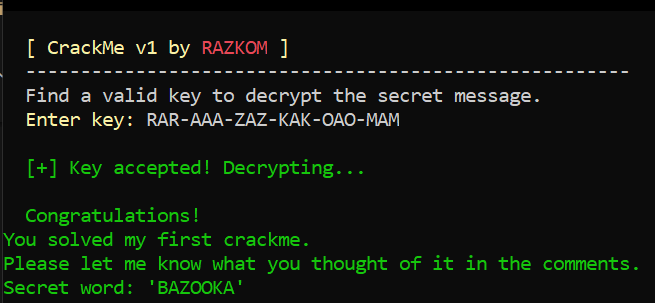
Secret word shown
Hooray!! we got it
Conclusions
Although the validation logic initially appears complex, removing compiler noise reveals a simple mathematical structure:
x(i) + x(i+1) ≡ x(i+2) (mod 26)
Each 3-character block follows modular arithmetic over the alphabet, with the third letters spelling:
RAZKOM
The key must follow a strict format (length 23 with fixed dashes), but the modular system itself is underdetermined:
26^6 possible valid keys
Ultimately, the challenge is not about brute force, but about recognizing the pattern, converting ASCII into alphabet space, and reducing the validation logic to clean modular arithmetic.